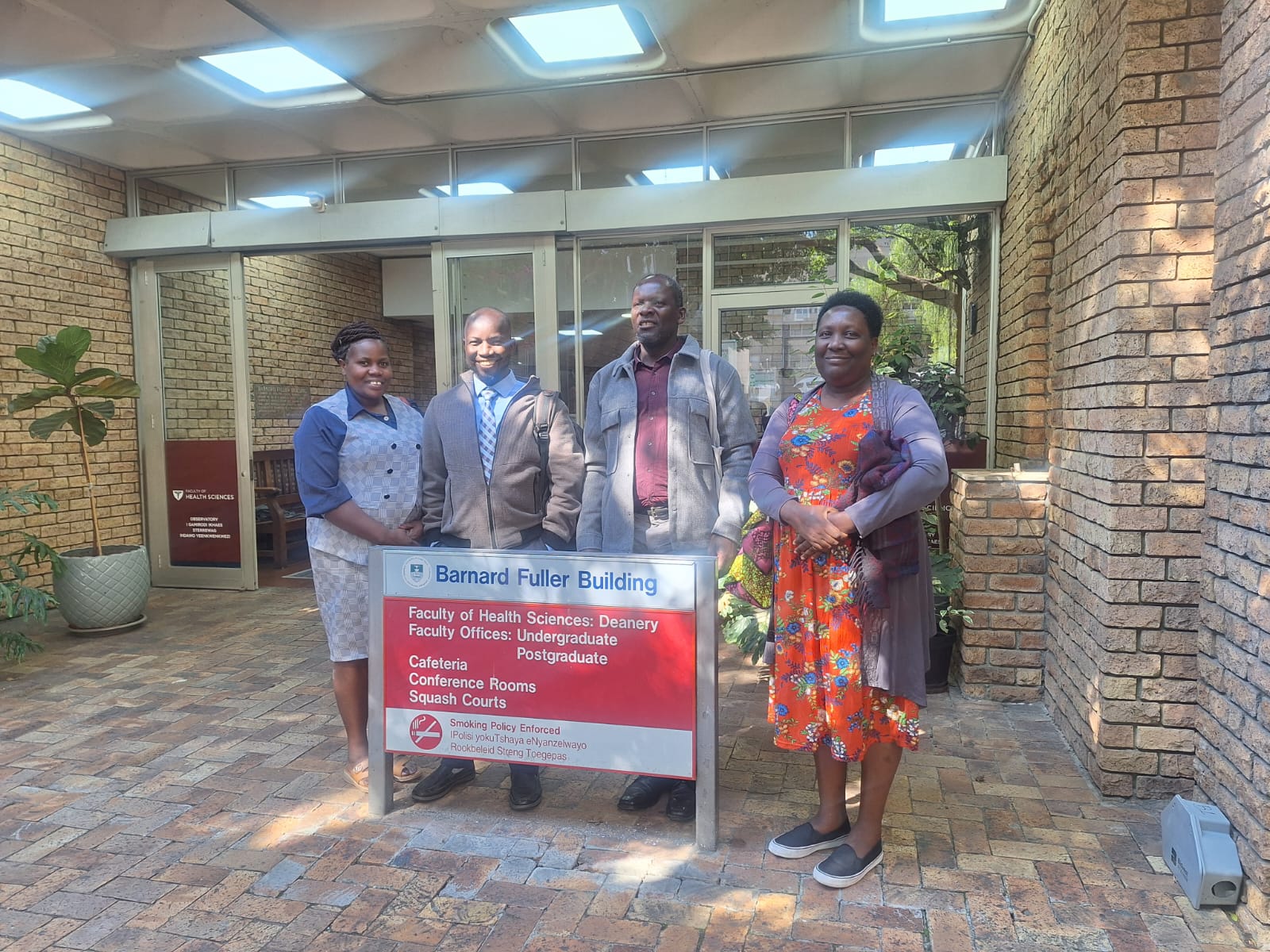
Makerere University's College of Health Sciences (CHS) has taken another significant step towards strengthening academic excellence following a successful benchmarking visit to the University of Cape Town (UCT), South Africa, one of Africa's leading higher education institutions renowned for its robust quality assurance systems.
The week-long visit, held from 19th to 26th April 2026, brought together a four-member delegation from the College's Quality Assurance, Gender Mainstreaming and ICT Committee to study UCT's approaches to quality assurance, governance, teaching and learning, and institutional leadership.
The delegation was led by Prof. Annet Kutesa, Dean of the School of Dentistry, and included Dr. Irene Rebecca Namatende, Quality Assurance Officer; Dr. Kalidi Rajab, Lecturer in the Department of Pharmacy and member of the College Quality Assurance Committee; and Mr. Herbert Bataamye, College Registrar.
The visit aimed to identify international best practices that can be adapted to further strengthen quality assurance systems at Makerere University while opening new avenues for institutional collaboration, academic exchange, and continuous improvement.
Learning from a Continental Leader in Higher Education
Recognized as one of Africa's top-ranked universities, the University of Cape Town has established a comprehensive quality assurance framework that integrates teaching, research, governance, and institutional management. Throughout the visit, the Makerere delegation held discussions with UCT officials and examined the systems that underpin the university's commitment to academic excellence.
Speaking after the visit, Prof. Annet Kutesa described the experience as both enriching and transformative.
"Quality assurance is not simply about compliance. At UCT, we observed that it is embedded in every academic and administrative process, creating a culture where excellence becomes everyone's responsibility. These are valuable lessons that can strengthen our own systems as we continue positioning Makerere University among Africa's leading institutions."
The delegation observed that every academic programme at UCT undergoes rigorous scrutiny before approval by South Africa's Council on Higher Education (CHE). Programmes are comprehensively evaluated and reviewed every five years to ensure they remain relevant, responsive to national priorities, and aligned with international academic standards.
The team also noted the importance UCT places on maintaining the integrity of academic qualifications through detailed programme documentation, accountability to regulatory bodies, and transparent quality management systems.
Strengthening Governance Through Accountability
Beyond academic programmes, the delegation explored governance structures that promote transparency, shared responsibility, and continuous institutional improvement.
UCT's governance model encourages active staff participation in decision-making while fostering accountability at every level of the institution. Regular reviews and feedback mechanisms support evidence-based decision-making and ensure that quality remains central to institutional operations.
According to Dr. Irene Rebecca Namatende, the visit demonstrated that quality assurance is most effective when it is embraced across the entire institution.
"One of our biggest takeaways is that quality assurance cannot be confined to one office or committee. At UCT, every faculty, department and support unit owns the quality agenda. This institutional culture is something we can continue nurturing at Makerere."
Enhancing Teaching, Learning and Student Assessment
The benchmarking exercise also focused on teaching, learning and student assessment practices.
Among the notable observations was UCT's robust examination moderation system, where every course examination is reviewed by an external moderator appointed at the beginning of the academic year. The moderators evaluate examinations for fairness, academic rigor, and alignment with intended learning outcomes before making recommendations that inform institutional policy and future assessment practices.
The delegation also explored UCT's structured student feedback mechanisms and its effective integration of digital technologies to enhance teaching, learning, and student engagement.
Another notable practice is South Africa's National Benchmark Test, undertaken by students after secondary school to assess their readiness for university education.
Building a Culture of Continuous Improvement
The delegation further learned that academic staff promotion at UCT is largely competence-based, taking into account research productivity, postgraduate supervision, community engagement, teaching effectiveness, professional experience, and contributions to the university.
The visit reinforced the importance of embedding quality assurance within everyday institutional practice rather than treating it as a periodic compliance exercise.
Reflecting on the visit, Dr. Kalidi Rajab said the experience provided practical insights that will support ongoing quality enhancement initiatives within the College.
"Benchmarking allows us to reflect on our own practices while learning from institutions that have successfully built sustainable quality systems. We return with practical ideas that can strengthen programme review, examination quality, staff engagement and continuous improvement."
Strengthening Institutional Partnerships
Beyond benchmarking, the visit created opportunities for future collaboration between Makerere University and the University of Cape Town in areas including academic exchange, curriculum development, research collaboration, and institutional capacity building.
The delegation expressed appreciation to the Principal of the College of Health Sciences and the College Management Team for facilitating the visit, noting that the knowledge and experiences gained will contribute significantly to advancing Makerere University's strategic commitment to quality teaching, impactful research, and excellent service to society.
As Makerere University continues implementing its strategic agenda, such international engagements remain instrumental in ensuring that its academic programmes and institutional practices remain globally competitive while responding to national and regional development priorities.