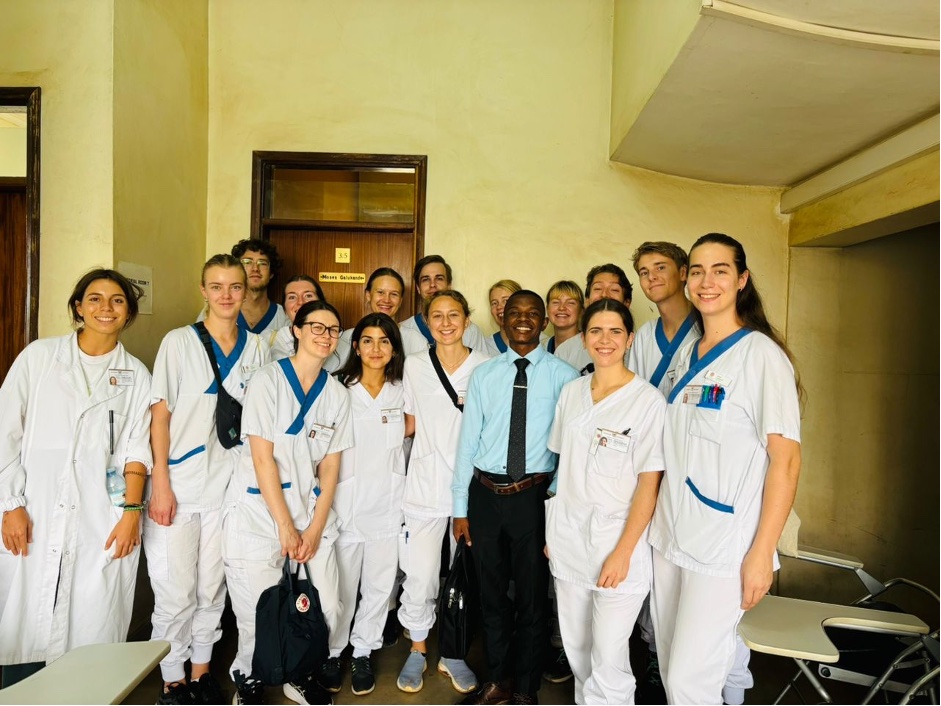
By Kenneth Tuyisenge
For the three years I have been a student buddy, the experience has been enriching. The Global friends is a student buddy at MakCHS that is in charge of orientation and cultural immersion for all international students. The first questions are almost always the same. “Is it safe to take a boda boda?” “How do I greet in Luganda? “It usually comes within the first hour right after introductions, before the campus tour is even halfway done. There’s a mix of curiosity and hesitation in their voice, and I’ve learned to smile before answering. By the end of the week, they are no longer asking if they should take a boda boda, they are negotiating prices in Luganda, laughing through traffic, and telling stories that begin with, “You won’t believe what happened on the way to Mulago…” That transformation from uncertainty to confidence is the quiet magic of being a student buddy at the International Office of MakCHS.
Being a student buddy has quietly trained me in skills no lecture has ever examined how to communicate across cultures without losing meaning, how to lead without imposing, and how to make someone feel at home in a place that is entirely unfamiliar to them. It has taught me patience in moments of misunderstanding, and humility in moments of exchange. Some of the most memorable lessons have come from the simplest moments. Sharing a meal and explaining why we eat what we eat. Translating a joke that somehow loses meaning halfway through. Watching someone try their first Rolex (the Ugandan kind) and immediately plan to have another. These small, human interactions often matter more than the formal orientation sessions they are where real connection happens. There are also moments that stay with you longer.
Besides social activities, we integrate visiting students into the learning environment at MakCHS. we walk students through their first experience on a crowded ward and watching their initial discomfort turn into thoughtful engagement or seeing them, weeks later, confidently presenting a case, fully immersed in an environment that once felt foreign. Those moments remind me that this role is not just about logistics it is about transformation.
My role as a student buddy begins where Google Maps and orientation booklets fail. I meet international students not just at the gates of the university, but at the intersection of cultures, expectations, and lived realities.I walk them through lecture rooms, hospital wards, cafeterias, and sometimes the unspoken rules of navigating both. I answer questions they ask out loud and the ones they don’t. Because the truth is, coming to Uganda for a global health rotation is not just an academic decision, it is an emotional and cultural leap.
I have seen students arrive with carefully structured expectations of healthcare systems, only to encounter the dynamic, resource-limited, yet deeply resilient environment of Mulago Hospital. At first, it can be overwhelming the patient load, the improvisation, the pace. But slowly, something shifts. They begin to see not just the gaps, but the ingenuity. Not just the challenges, but the strength of systems held together by commitment and adaptability. And somewhere in that process, I find myself learning just as much as they do.
By the time their rotation ends, the change is always visible. The nervous student at the gate becomes someone who knows the shortcuts around campus, who greets staff with ease, who understands not just intellectually, but personally what global health really means.
And then comes the goodbye. It is never just a farewell; it is a quiet acknowledgment of a shared journey. They leave with photos, stories, and a deeper appreciation of Uganda. I remain with new perspectives, new friendships, and the quiet satisfaction of having made their transition a little easier. Looking back, being a student buddy has been more than a volunteer role. It has been a continuous lesson in empathy, adaptability, and connection. It has shown me that medicine is not confined to textbooks or hospital walls it lives in conversations, in shared experiences, and in the willingness to understand one another across borders.
If there is one thing this journey has taught me, it is this: sometimes, the most meaningful impact is not made in grand gestures, but in simple acts meeting someone where they are, and walking with them until they find their footing.